

English vocabulary building starts with small habits. No one becomes fluent in English overnight. Every student who speaks confidently today was once confused about words, pronunciation, or sentence formation. That is a normal part of learning.
The good thing is, improving vocabulary does not need to feel stressful. Reading a little, listening carefully, and speaking whenever possible can slowly build confidence. Even spending ten minutes a day with English can make a real difference after a few weeks.
English Vocabulary Building Through Daily Reading
Reading is one of the easiest ways to improve vocabulary naturally. When students read stories, comics, subtitles, or short articles, they start understanding how words are actually used in real sentences.
Students can begin with simple things like:
- Comic stories
- English subtitles while watching videos
- Short textbook paragraphs
- Quotes or captions on social media
It is completely okay not to understand every word. What matters most is reading consistently. This is one of the best word learning tips because seeing words again and again helps students remember them without much effort.
Slowly, students begin understanding sentence patterns and using new words more confidently while speaking.
What Are The Easy Ways to Learn English Words?
Trying to memorize too many words in one day usually does not work well. Most students forget them quickly. Words stay longer in memory when they are used naturally in daily life.
English vocabulary building becomes easier when students focus on small daily practice instead of difficult memorization.
Simple methods include:
- Learning one new word every day
- Using that word in simple sentences
- Writing words on sticky notes
- Saying words aloud to improve pronunciation
- Keeping a small vocabulary notebook
Learning feels more interesting when words connect to real situations. For example, students remember the word “hungry” faster when they actually use it during the day.
Common English Words Students Should Know
Students do not need thousands of words to start speaking English. Learning basic and commonly used words first is enough to build confidence.
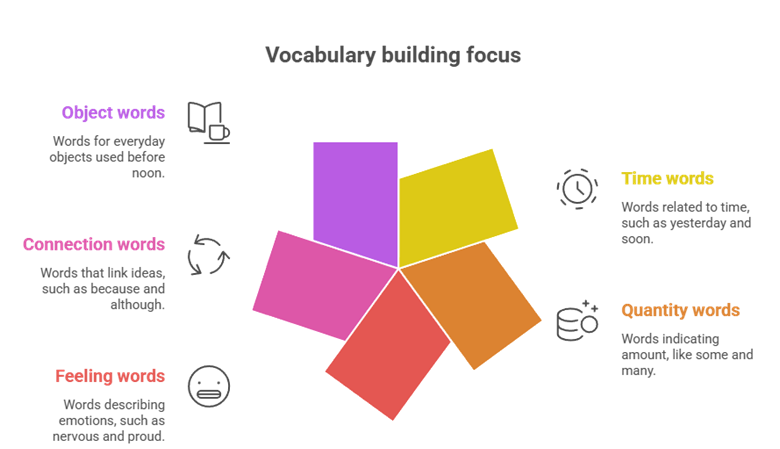
Useful word groups include:
- Time words — before, after, tomorrow
- Feeling words — excited, nervous, proud
- Quantity words — many, few, enough
- Connection words — because, although, meanwhile
- Names of everyday objects used at home or school
These are words students hear regularly in conversations, classrooms, and videos. One of the most useful word learning tips is to notice and learn words that appear often in daily life.
Once these basics become familiar, speaking English starts feeling much more comfortable.
How Daily Practice Makes English Conversations Easier?
Daily speaking practice helps English vocabulary building become more natural for students. Many students avoid speaking because they are scared of making mistakes. But mistakes are actually part of learning.
Students can practice by:
- Talking about daily activities in English
- Speaking with friends for a few minutes every day
- Repeating sentences from videos
- Explaining short videos in simple English
- Practicing in front of a mirror
At first, speaking may feel awkward or uncomfortable. Students may pause often or forget words. Over time, regular speaking practice makes conversations smoother and easier. Following simple word learning tips every day can slowly improve fluency and confidence.
Learning English takes patience and regular effort. Reading, listening, writing, and speaking a little every day can slowly improve vocabulary and communication skills. In the end, English vocabulary building is simply about improving little by little every day until speaking English starts feeling natural.
Visit Kanavu School of English to explore student-friendly programs that help learners improve English communication with confidence.